The faith cycle
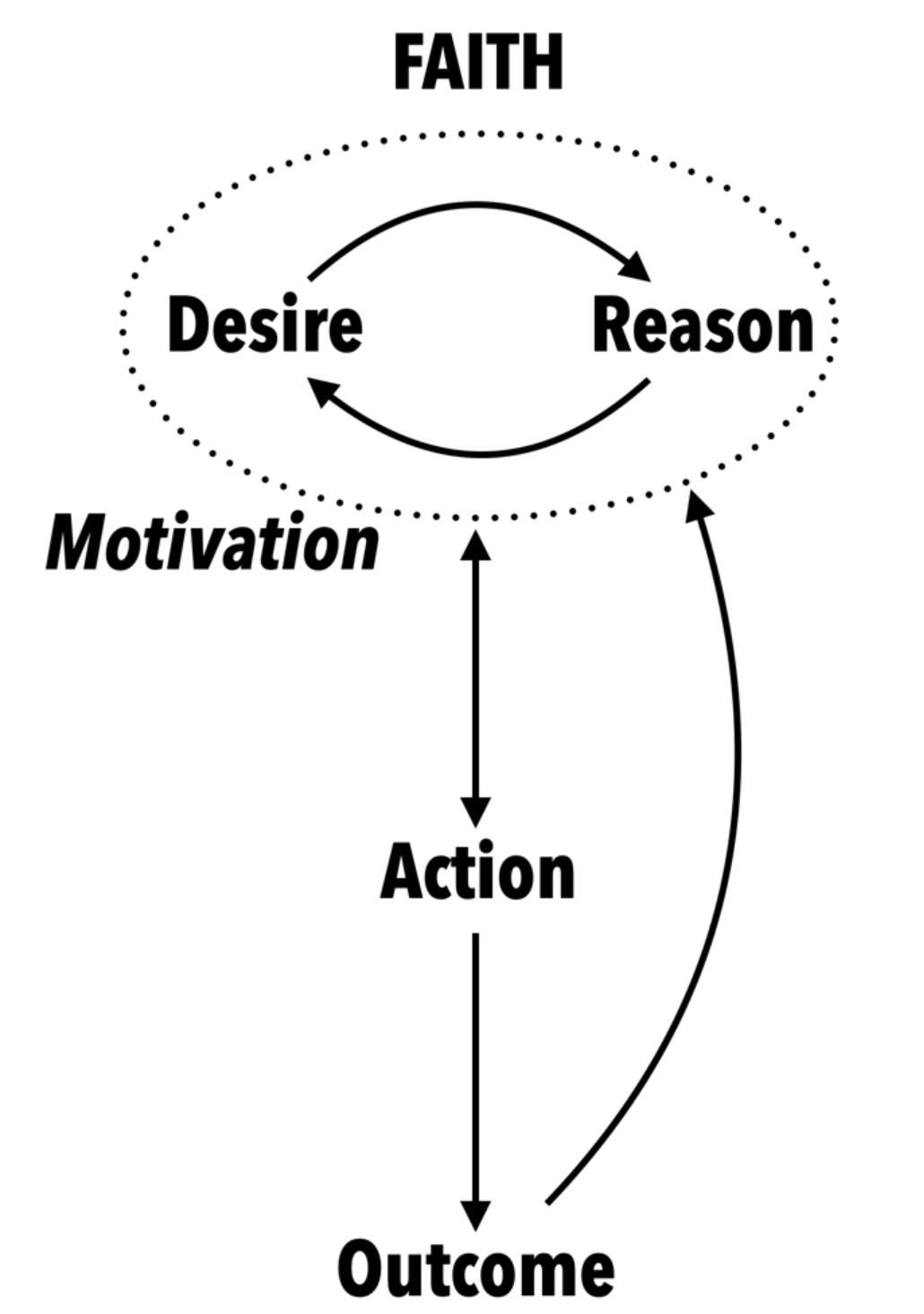
Faith is not a product. It is a process. It is something you do, not something you have. Faith is to outcomes what wisdom is to knowledge. The one is a process whereby you generate the other.
Describing faith as a process provides insight on what faith really is, how we can act according to faith, how we can increase our faith, and how we can help others to do the same.
Peter speaks of adding “to your faith virtue; and to virtue knowledge;” (2 Peter 1:5) It is through the process of faith that we become better, and it is through doing so that we gain knowledge. The price of faith is to believe what you do not yet see. The reward of faith is to see what you believed come to pass.1
Faith is a mental exercise where you explicitly consider things, open your mind to new ideas, think about what you really desire and why, apply everything you’ve observed, challenge your feelings, question your preconceived notions, and marshal the courage and audacity necessary to walk straight into the unknown. It is the only way to resolve the otherwise mutual exclusivity of deep confidence and absolute willingness to be wrong, both of which are required to obtain the greatest outcomes.
Faith consists of desire, gaining reasons, acting, obtaining outcomes, and knowing.
Desire answers the question, what do you want? Desire is not about what you say you want, or what others want for you. It is about what you really want, deep down inside.
Reason answers the question, why do you want it? Why should you seek the outcome you desire? Why do you want what you desire? Why is what you want better than any alternative? Why does the desired outcome occur, or, in other words, what is the mechanism that results in what you seek? Why should you believe that the actions you consider will lead to the outcome you seek?
Motivation is the combination of desire and reason. Desire is emotion, reason is logic. Together, they form your motivation for action. Each aspect of motivation has strengths and weaknesses.
Emotion can impart momentum to action in a way that most people fail to achieve with reason alone, but emotions are less likely to be aligned with reality and less likely to endure than reason.
Action answers the question, how? Action consists of enumerating what things you will do to obtain what you seek, and actually doing those things. What many call “faith” is suspiciously devoid of action. Faith is a principle of action, and action is what distinguishes faith from wishing. You can wish anything you want, but if you don’t do anything about it, it can’t be faith.
Outcomes are what well-reasoned and sufficiently-desired actions produce.
Knowing refers to obtaining, through your personal experience, the outcome you seek. Once you have obtained the outcome, you have completed a circuit of the faith cycle by replacing your faith with knowledge. Knowledge is also gained throughout the faith process, as developing desires, exercising reason, taking actions, and receiving outcomes all result in increased knowledge.
Footnotes
- 1. Adapted from Augustine of Hippo. ↩