Chapter 1: Faith is a Process
The power of a model
As sentient beings, humans have the power to choose how they act based on their thoughts. This capability is useful only to the extent that we recognize and correctly understand the relationships between cause and effect.
Models are an effective way to explicitly state our understanding of a system. Models are characterizations of relationships between entities in a system. The purpose of a model is to reveal what actions will yield a desired effect. While the complexity and indeterminate nature of reality suggest limits to any finite model, models are nevertheless powerful tools to increase the reach of our understanding and the intentionality of our actions.
The faith cycle
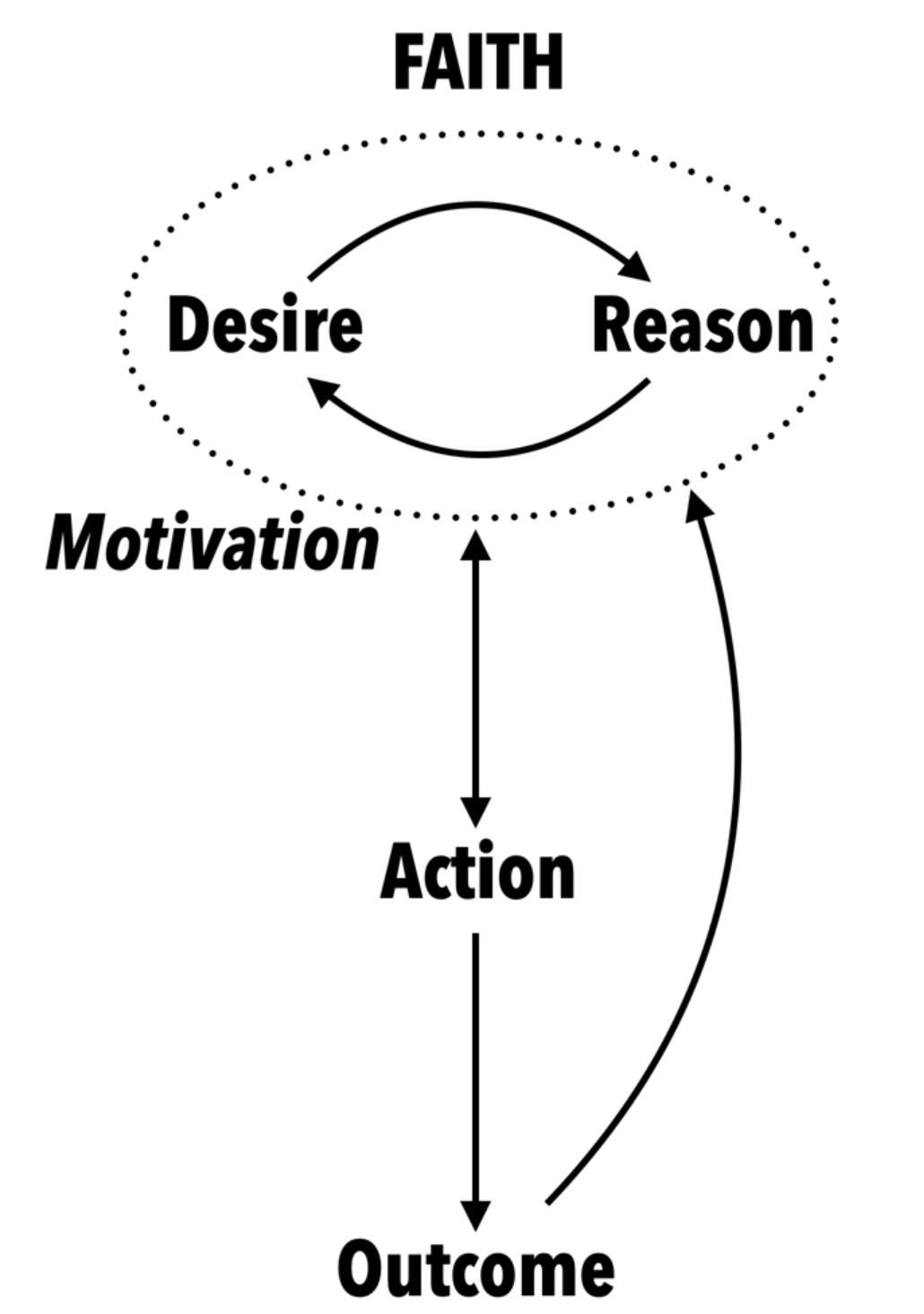
Faith is not a product. It is a process. It is something you do, not something you have. Faith is to outcomes what wisdom is to knowledge. The one is a process whereby you generate the other.
Describing faith as a process provides insight on what faith really is, how we can act according to faith, how we can increase our faith, and how we can help others to do the same.
Peter speaks of adding “to your faith virtue; and to virtue knowledge;” (2 Peter 1:5) It is through the process of faith that we become better, and it is through doing so that we gain knowledge. The price of faith is to believe what you do not yet see. The reward of faith is to see what you believed come to pass.1
Faith is a mental exercise where you explicitly consider things, open your mind to new ideas, think about what you really desire and why, apply everything you’ve observed, challenge your feelings, question your preconceived notions, and marshal the courage and audacity necessary to walk straight into the unknown. It is the only way to resolve the otherwise mutual exclusivity of deep confidence and absolute willingness to be wrong, both of which are required to obtain the greatest outcomes.
Faith consists of desire, gaining reasons, acting, obtaining outcomes, and knowing.
Desire answers the question, what do you want? Desire is not about what you say you want, or what others want for you. It is about what you really want, deep down inside.
Reason answers the question, why do you want it? Why should you seek the outcome you desire? Why do you want what you desire? Why is what you want better than any alternative? Why does the desired outcome occur, or, in other words, what is the mechanism that results in what you seek? Why should you believe that the actions you consider will lead to the outcome you seek?
Motivation is the combination of desire and reason. Desire is emotion, reason is logic. Together, they form your motivation for action. Each aspect of motivation has strengths and weaknesses.
Emotion can impart momentum to action in a way that most people fail to achieve with reason alone, but emotions are less likely to be aligned with reality and less likely to endure than reason.
Action answers the question, how? Action consists of enumerating what things you will do to obtain what you seek, and actually doing those things. What many call “faith” is suspiciously devoid of action. Faith is a principle of action, and action is what distinguishes faith from wishing. You can wish anything you want, but if you don’t do anything about it, it can’t be faith.
Outcomes are what well-reasoned and sufficiently-desired actions produce.
Knowing refers to obtaining, through your personal experience, the outcome you seek. Once you have obtained the outcome, you have completed a circuit of the faith cycle by replacing your faith with knowledge. Knowledge is also gained throughout the faith process, as developing desires, exercising reason, taking actions, and receiving outcomes all result in increased knowledge.
Pain creates an obstacle in the faith cycle
In each phase of the faith cycle, pain serves as an obstacle to progress. It hurts to change your desires. It is unpleasant to realize your desires are inclined towards something less than what you thought. It is painful to uproot a deep-seated desire.
It hurts to exercise reason. It is unpleasant to overcome irrational emotion. It can be painful to fight misplaced desire with logic. It takes effort to learn and to recognize and fight against mental biases.
It hurts to act towards the outcomes we seek. Effort is never easy, and things of greater worth almost always require not just more effort, but much greater effort. Action almost always reveals that the path is much harder than you expected. It hurts to realize that what you seek will require far greater effort, far greater sacrifice, and much more time than you thought.
Without faith, the inevitable pain present in each step of the faith cycle will waylay you. With faith, you can conquer the obstacles of discomfort and toil that lie between your present circumstances and the outcomes you seek.
Obtaining through faith
Faith concerns itself with the habitual discovery and implementation of efficacious actions. Exercising faith will lead the individual to continued improvement and inevitable joy:
And moreover, I would desire that ye should consider on the blessed and happy state of those that keep the commandments of God. For behold, they are blessed in all things, both temporal and spiritual; and if they hold out faithful to the end they are received into heaven, that thereby they may dwell with God in a state of never-ending happiness. O remember, remember that these things are true; for the Lord God hath spoken it. (Mosiah 2:41)
Faith is the process by which potential is transformed into existence. It is the means by which the information present in the spirit is discovered and instantiated into physical reality. It is the means by which the image of God is extracted and applied to the world to yield something in greater fidelity to the creator.
Faith means daring to dream of outcomes that would otherwise not happen, searching for a path to obtain them, and exercising both obedience to the path and sufficient effort to obtain them. Following this pattern is what Jesus meant when he used words like ask, seek, and knock.
Asking doesn’t mean wishing. It means putting in the necessary effort and obedience to discover the path to what you desire, then exercising the necessary effort and obedience to traverse that path and obtain what you desire.
Catalysts in the process
Faithful people are catalysts. They will improve the circumstances of themselves and those around them no matter into what environment you place them. They serve as direct catalysts by personally obtaining the outcomes they seek through faith, as well as indirect catalysts when their examples give others reasons to believe that they might do the same.
Joseph, son of Jacob, was placed in a pit, but he ended up the second most powerful and the first most important man in the world. When he was put into slavery, he was made the commander of the slaves. When he was put into prison, he was made commander of the prison. Everything put into his hands prospered, because he had faith. He applied his ability to ideate and act to his surroundings, and he reshaped them in the image of the power of his mind. His story as recorded in scripture serves as a powerful example of what can be accomplished and demonstrated to others, through faith, even in the most trying of circumstances.
Faith doesn’t play favorites. It yields the same types of results for everyone who puts it into practice. You, too, will become a catalyst for improvement in this world as you deliberately strive to strengthen your faith.
Footnotes
- 1. Adapted from Augustine of Hippo. ↩